
A LITANY FOR THE
CHURCH IN OUR TIMES
THE FIVE FIRST SATURDAYS IS A DEVOTION NEEDED NOW MORE THAN EVER! FIND OUT MORE HERE
THE SAINT MICHAEL PRAYER AND THE ROSARY
ARE ALSO POWERFUL PRAYERS TO HELP US THROUGH THESE VERY TURBULENT TIMES!
HIGHLY RECOMMENDED! DELIVERANCE PRAYERS,
A BOOK FROM SENSUS TRADITIONIS PRESS
(A GREAT PUBLISHER HELPING US FIGHT OUR MANY SPIRITUAL BATTLES NOWADAYS)!
CHECK OUT OUR PODCAST PAGE AND OUR YOUTUBE CHANNEL FOR INSPIRING CONTENT
BISHOP STRICKLAND HAS SUGGESTED A POWERFUL REMEDY IN REPARATION FOR SO MANY EVILS TODAY THAT CAN ALSO HELP YOU ADVANCE IN HOLINESS! THERE'S MORE INFORMATION HERE!
SEPTEMBER 15TH MARKS THE MEMORIAL OF OUR LADY OF SORROWS AS DISCUSSED HERE

THIS WEBPAGE IS ALSO AVAILABLE
AS A PODCAST HERE
This prayer below is known as the Litany for the Church in Our Times. Its tone might seem a little harsh, even alarmist, for many people, certainly not in keeping with the warm tones of desire for inclusivity above all else that pervades much clerical thinking in Catholicism these days.
There are several appeals for assistance from some of our great saints in this prayer, that they might help our somewhat wayward church get back to basics in caring for and saving souls focusing in a Christ centered faith, rather than what LifeSite News journalist Frank Wright has called today’s more subjectively “person centered” one!
Wright expresses the well-founded concern here that many in the clergy are emphasizing person-centered or humanistic ways of looking at the church without explicitly grounding them in Jesus Christ.
As he put it so well in a LifeSite News Faith and Reason Podcast, under Pope Leo XIV, the church risks “shifting the perception of Catholics towards the idea of our religion away from the supernatural reality of Christ and towards simply the perspectives, sentiments, feelings, and preferences of other human beings.”
As a result, there is less and less emphasis on the realities of sin, repentance, salvation, and eternal life and more and more on primarily humanistic concerns, sentiments, and desires.
In prayers such as this litany below we can pray that in whatever way the barque of St. Peter, as the church is known, is running adrift these days, that it will cease being tossed to and fro by the stormy waves of relativism and humanistic thinking (which gravitates towards a secular mindset) but rather that our prelates, with help from the laity, will right that ship to go on its traditional even keel.
Whether or not you agree that the church is in a state of crisis or not, this prayer nonetheless makes supplication for everything we should want for our Lord’s Mystical Body, as the church is known!
V. Lord, have mercy.
R. Christ, have mercy.
V.Lord, have mercy on us. Christ, Divine Founder of the Church,
R.Hear us.
V. Christ, Who didst warn of false prophets,
R. Graciously hear us.
God, the Father of Heaven,
Have mercy on us.
God, the Son, Redeemer of the World,
Have mercy on us.
God, the Holy Ghost,
Have mercy on us.
Holy Trinity, One God,
Have mercy on us.
Holy Mary, Mother of God, Pray for us. (repeat after each line)
St. Joseph, Patron of the Universal Church,
St. Michael, Defender in Battle,
St. Peter, the Rock upon which Christ built His Church,
St. Paul, Protector of the Faithful Remnant,
St. Francis of Assisi, Re-builder of the Church,
St. Anthony, Hammer of Heretics,
St. Pius V, Restorer of the beauty of the Sacred Liturgy,
St. Pius X, Foe of Modernism,
All ye Holy Angels and Archangels,
Pray that we may resist the snares of the Devil.
St. Catherine of Siena,
Pray that Christ's Vicar may oppose the spirit of the world.
St. John Fisher,
pray that bishops may have the courage to combat heresy and irreverence.
St, Francis Xavier, pray that zeal for souls may be re-enkindled in the clergy.
St. Charles Borromeo,
pray that seminaries may be protected from false teachings.
St. Vincent de Paul,
pray that seminarians may return to a life of prayer and meditation.
St. Therese of the Child Jesus,
pray that religious may rediscover their vocation of love and sacrifice.
St. Thomas More,
pray that the laity may not succumb to the Great Apostasy.
St. Francis de Sales, pray that the Catholic press may again become a vehicle of Truth.
St. John Bosco,
pray that our children may be protected from immoral and heretical instruction.
St. Pascal Baylon,
pray that profound reverence for the Most Blessed Sacrament may be restored.
St. Dominic,
pray that we may ever treasure the Holy Rosary.
V. Lamb of God, Who takest away the sins of the world,
Spare us, O Lord.
V.Lamb of God, Who takest away the sins of the world,
Graciously hear us, O Lord
V. Lamb of God, Who takest away the sins of the world,
R.have mercy on us.
V.Christ, hear us.
R.Christ, graciously hear us.
V.Pray for us, O Holy Mother of God,
R.That we may be made worthy of the promises of Christ.
Let Us Pray. Jesus, our God, in these dark hours when Thy Mystical Body is undergoing its own Crucifixion, and when it would almost seem to be abandoned
by God the Father, have mercy, we beg of Thee, on Thy suffering Church.
Send down upon us the Divine Consoler, to enlighten our minds and strengthen our wills.
Thou, O Second Person of the Most Holy Trinity, Who canst neither deceive nor be deceived, have promised to be with Thy Church until the end of time.
Give us a mighty Faith that we may not falter; help us to do Thy Holy Will always, especially during these hours of grief and uncertainty. May Thy Most Sacred Heart and the Immaculate and Sorrowful Heart of Thy Holy Mother be our sure refuge in time and in eternity. Amen.
There have been a number of prophetic references to Catholicism’s being in a future state of trial, confusion, division and even perhaps apostasy from both public and private (church approved) revelations.
Jesus Himself asked this prophetic challenging question: "When the Son of Man comes (in His Second Coming), will he find faith on earth?" (Luke 18:8) Indeed as we read in the Catechism of the Catholic Church, paragraph 275, "Before Christ's second coming the Church must pass through a final trial that will shake the faith of many believers".
And, for another chilling prophecy, Our Lady of Akita, told Sister Agnes Sasagawa, in Akita, Japan on October 13, 1973 that "The work of the devil will infiltrate even into the Church in such a way that one will see cardinals opposing cardinals, bishops against bishops…the Church will be full of those who accept compromises and the demon will press many priests and consecrated souls to leave the service of the Lord.” While we may not be there yet, we are in danger of moving more and more in that Apostatic trajectory.
In addition, the horrible scandals in the clergy over the past several decades have depleted many church coffers in sex abuse settlements. That, and a drop off in parish and Mass attendance, have caused many parishes to close or to merge with existing parishes, offering the laity fewer opportunities to participate in church life and grow in sanctity.
Whether you think it’s because of or in spite of the Second Vatican Counsel’s efforts to meet the needs of the modern age in church teaching, the numbers of religious, parishes, and church attendance, have dropped precipitously in the past 60 years since the close of the counsel in 1965.
Since then we’ve also seen a distressingly large number of poorly catechized Catholics, with only 69% of regular Mass going Catholics believing in our fundamental doctrine of Jesus’ Real Presence, body, blood, soul, and divinity in the Eucharist.
And there have been erroneous attempts to teach people about Jesus without His supernatural charism. You or someone you know perhaps, might have heard the claim that the real story of the Miracle of the Loaves and Fishes was not that Jesus was able to feed 5000 people, and then 4000 more, starting with just a few barley loaves and a few fish, but instead, that everyone was moved to share what they had already brought!
While this might be a nice way to teach people a lesson about the value of sharing, we must remember that, for all practical purposes, noone brought their own food!
There was a similarly pernicious notion being taught for a few decades after Vatican II denying the historicity of Christ’s Resurrection, reducing it to the disciples’ subjective feelings or visions about this event, and that Christ’s empty tomb was merely symbolic.
Then there are what are known in Catholicism as the Four Last Things following our earthly existence: Death, Judgment, Heaven, and Hell. While these have traditionally been an important part of church teachings, over the past few decades they have been reduced to two in many people’s minds and in clerical homilies as well, namely Death and Heaven.
The notion that we are sinful beings needing to repent of our sins has been downplayed in the name of stressing God’s great mercy. Hell might as well have been replaced by Heck, and after all no one's there, except maybe Hitler and some other murderous types.
And while our Lord is indeed merciful, as He stressed to St. Faustina, a Polish Nun in the 1930’s to whom he gave His great prayer the Divine Mercy Chaplet for all of us, He nonetheless wants us to acknowledge our sins as such and fight our sinful proclivities in prayer and penance, availing ourselves as part of the Sacramental life, of regular Confession.
There, God can forgive our sins, and to firm up our purpose of amendment to fight against further committing them as needed.
Pope Francis, in his famous statement about proselytism being "solemn nonsense” supposedly meant that we should not try to coerce anyone into conversion.
Yet, the upshot of this has increasingly been that the Great Commission given by Christ Himself after His Resurrection at the end of Matthew’s Gospel that "All authority in heaven and on earth has been given to me. Go therefore and make disciples of all nations, baptizing them in the name of the Father and of the Son and of the Holy Spirit, teaching them to observe all that I have commanded you" (Matt 28:18-20), the Great Commission, has become a nice suggestion.
The church’s outreach to those of other beliefs among the world’s major religions, while meant to be compassionate, nonetheless dilutes the uniquely salvific nurture of our faith as exemplified by Jesus’ famous words that "I am the way, and the truth, and the life; no one comes to the Father, but by me” (John 14:6).
While Jesus assured Peter that the gates of Hell would not prevail against His church (Matt 16:18), nonetheless we have been plagued, especially in the last 60 years or so, since Vatican II, with a return to a spirit of Modernism.
Modernism was condemned by Pope Pius X as the "synthesis of all heresies" as it was gaining support in many in the Catholic laity, and in the ranks of the priesthood itself, in his encyclical Pascendi Dominici Gregis (in English “Feeding the Lord’s Flock”) in 1907.
In this encyclical, the Holy Father denounced the scurrilous attacks on the faith, as well described by Jimmy Akin in this article on the Catholic Answers website, including the notions that God could not be proven to exist by natural reason; that modern man could dispense with beliefs in supernatural revelations such as miracles and prophecies; that not only did Jesus not found our church, but that its essential structure, and even its dogmas, could change or evolve to keep up with the times.
(This is not to say that the church cannot respond to changing times within the framework of its Magisterium, that is its sacred teaching authority. It does and has done so through Papal encyclicals and ecumenical councils over the past two millennia.)
The gist of all this is that our faith, in modernist thinking, can be viewed in subjective terms by each of us, rather than those objectively given by Divine authority from the great theologians, saints, and Doctors of the Church.
To combat any confusion, Pope Pius X instituted and required an oath against Modernism in 1910 for all religious including priests, seminarians, theology and philosophy professors, religious superiors, and local pastors, which the late Father John Hardon once aptly summed up as being “the demonstrability of God's existence by human reason, the value of miracles and prophecies as criteria of revelation, the historical institution of the Church founded by Christ, the invariable constancy of the essentials of Catholic tradition, and the reasonableness and supernaturality of the Christian faith.” in his Modern Catholic Dictionary.
The Oath was itself rescinded on July 17th, 1967 by the Congregation for the Doctrine of the Faith, with the approval of Pope Paul VI. It was replaced with a new Profession of Faith and Oath of Fidelity. These newer forms affirm Catholic doctrine and obedience to the Magisterium but omit the explicit anti-Modernist condemnations of 1910.
And while I by no means wish to calumniate the priesthood or any particular priest the church tragically the church has undergone much financial and reputational hardship with quite a loss of revenue and trust from settlements from those among seminarians, priests and even some of the laity afflicted by various degrees of clerical sexual harassment. This is especially scandalous, considering the fact that religious are called to live lives of chastity.
A distressingly large number of clerics, even among the higher ups, are either ambivalent or outright dismissive of such offenses against the sixth commandment and the heavy eternal punishment these can entail.
Jacinta Marto, one of the three visionaries who saw our Lady of Fatima in 1917, and were shown a frightening vision of Hell, related that it was conveyed to her that sins of the flesh, those unrepented sixth commandment violations against chastity, send most people to that realm of neverending torment.
Empathy, in itself, is not a bad thing. But empathy towards those struggling with addictions to pornography, and illicit sexual behavior such as adultery, fornication and any kind of same sex sexual encounters can be toxic if religious fail to stress the need for penitence and repentance from those involved in such activities.
While it is true that Jesus shamed those Pharisees ready to stone the woman caught in adultery to give up their lethal attempt to punish her by stoning, what did he tell her when they left? “Go and sin no more” (John 8:11)
You may have heard our church is being called these days to be a "church of accompaniment" in listening to the concerns of the laity in a spirit of evangelization.
But remember, Jesus would not have those involved accompany us on to committing further grave sins but rather to bolster our spirit of repentance of them with as firm a purpose of amendment as possible!
FROM OUR BOOK AND GIFT STORE
OR CAFE PRESS STORE!
Return from A Litany for the Church in Our Times
to Prayer Blog Page
Return from A Litany for the Church in Our Times
to Litanies


Recent Articles


-
Prayers to Our Lady as the Queen of Martyrs
Sep 13, 26 06:31 PM
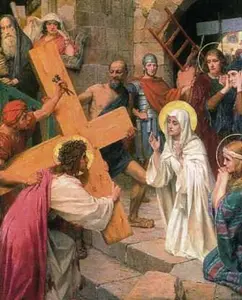 St. Alphonsus Liguori once wrote that Our Lady suffered a martyrdom in her soul at the foot of the cross in her Divine Son’s Crucifixion at Calvary.
 -
Who do you love, and how do you love? Jesus’ question for all of us!
Sep 03, 26 12:00 PM
 Our Lord might very well ask you when you pass away not just who you loved but how you loved them. Now more than ever strive to live the Gospel Message!
 -
Envy: A Particularly Toxic Vice!
Aug 17, 26 08:58 PM
 Does the green eyed monster of Jealousy make you see red at another’s good fortune? Don’t let envy eat away at your soul!
 -
Restless Hearts in Need of God’s Love and Protection
Jul 31, 26 03:10 PM
 St. Augustine wrote of God that “You have made us for Yourself, and our hearts are restless until they rest in You.” Turn to Him for His lasting peace!
 -
A Litany for the Church In Our Time: For the Good of the Church
Jul 15, 26 09:43 PM
 A Litany for the Church In Our Times: For Catholicism to fully reflect its founder Jesus Christ’s glory!
 -
Be A Light in the Darkness
Jun 24, 26 12:46 PM
 Jesus was a light in the darkness in His earthly ministry. Now is an especially good time to imitate Him in being a light for others in these dark times!
 -
Thirty Three Petitions to Jesus With Some Great Scriptural References
Jun 18, 26 10:05 PM
 These 33 petitions to Jesus can help you get closer to Jesus from its many scriptural descriptions of our Lord!
 -
A Prayer of Praise for the Sacred Heart of Jesus: for His Burning Love
Jun 03, 26 06:30 PM
 Do we give Jesus lip service or heart service? Let Devotion to the Sacred Heart of Jesus help you focus on His fiery love for you and for all of us!
 -
The Twelve Fruits of the Holy Spirit: Part of a Truly Blessed Life!
May 28, 26 08:50 PM
 The 12 Fruits of the Holy Spirit can give you tranquility and equanimity to live by the Spirit so that you may walk by the Spirit!
 -
Aspirations (Short Prayers) to the Blessed Virgin Mary
May 13, 26 05:09 PM
 Do you find you have no time for prayer? These short easy-to-remember prayers can help you find time and stay close to the Blessed Virgin Mary and Jesus!
 -
The Road to Emmaus and the Disciples' Memorable Meeting with Jesus
Apr 30, 26 11:21 AM
 The Disciples on the Rad to Emmaus' hearts burned as Jesus opened the scriptures referring to Himself, and they recognized Him in the breaking of the bread!
 -
What's it to you? Jesus on the Most Important Vocation
Apr 21, 26 07:29 PM
 Jesus response to Peter's question about his fellow Apostle John, "Lord, what about this man?" applies to us as well!